Given the robust nature of learning sciences research, this website is best viewed on tablets and computers. A small screen experience is coming in the future.
On June 22, 2021, we will launch updated strategies for the Math PK-2 model, as well as additional updates to the Navigator that highlight equity, SEL, and culturally responsive teaching. To learn more, visit our Site Updates (available in the "About" menu at the top of any page).

Expand domains to explore factors connected with Cognitive Flexibility, then select factors to explore related strategies.

Cognitive Flexibility, a component of executive functioning, is the ability to flexibly shift Attention between tasks. It is our ability to recognize when rules change, allowing us to think in new ways, act creatively, and solve problems. Cognitive Flexibility can also be called set shifting or task switching as it involves shifting Attention away from one idea or task component and responding to a new or different idea or task component. It thereby supports our ability to see things from other people's perspectives, including understanding the value of the content they are learning. Cognitive Flexibility can be used to effectively adapt behavior in the face of changing environments and task demands: for instance, in school, students must consider and switch between different rules and strategies to complete learning tasks. Cognitive Flexibility is central to Creativity, problem solving, and learning.
Students explaining their thinking during learning is a metacognitive process that involves actively self-questioning or being questioned while exploring new concepts, and explaining thoughts and reasoning in response.
Games support learning, as learners engage with new information in fun and informal ways.
Gallery walks are ways of showcasing content and materials as multiple “exhibitions” for students to view and interact with as part of larger learning goals.
As learners work together to solve problems, they learn new strategies and practice Communication skills as they express their academic thinking.
Read-alouds are an instructional practice in which teachers read aloud from a text to students, modeling fluent reading, asking questions, and actively engaging with students to enhance their understanding.
In guided inquiry, teachers scaffold student learning and help students use their own language to construct knowledge by active listening and questioning.
Goal-setting and monitoring involves teachers working with students to set individualized academic or behavioral goals, plan actions to achieve those goals, and track progress.
When students are able to encourage themselves through kind and motivating self-statements, they are practicing positive self-talk.
Physical activity and recess refer to designated times and activities that allow students to engage in movement, play, and exercise, promoting physical and mental well-being.
Physical activity and recess in early childhood provides social, physical, and mental benefits to learners.
Feedback is the process of providing learners with information about their learning to support their progress and improvement, and can come from a range of sources, including teachers and peers.
Creating a culture of error means creating an environment in which errors are valued and encouraged as a necessary part of the learning process, which can help learners to view errors and learn more positively.
Simulations involve students engaging in interactive experiences that mimic real-world scenarios to explore content, practice skills, and solve problems.
Retrieval practice requires students to access information, or get information “out” from Long-term memory in order to support better retention and understanding.
Graphic organizers—including advance organizers—are powerful instructional tools that help students visualize how ideas fit together, supporting the construction of meaning and strengthening recall across content area.
Pre-assessments are tools or activities used before instruction begins to help educators understand what students already know, understand, or can do—and where they may need support.
When classrooms are intentionally designed to promote inclusion, belonging, and accessibility, they positively influence key learner factors, including Attention, Self-Regulation, Learner Mindset, and Sense of Belonging.
 Except where otherwise noted, content on this site is licensed under a Creative Commons Attribution-NonCommercial 4.0 International License
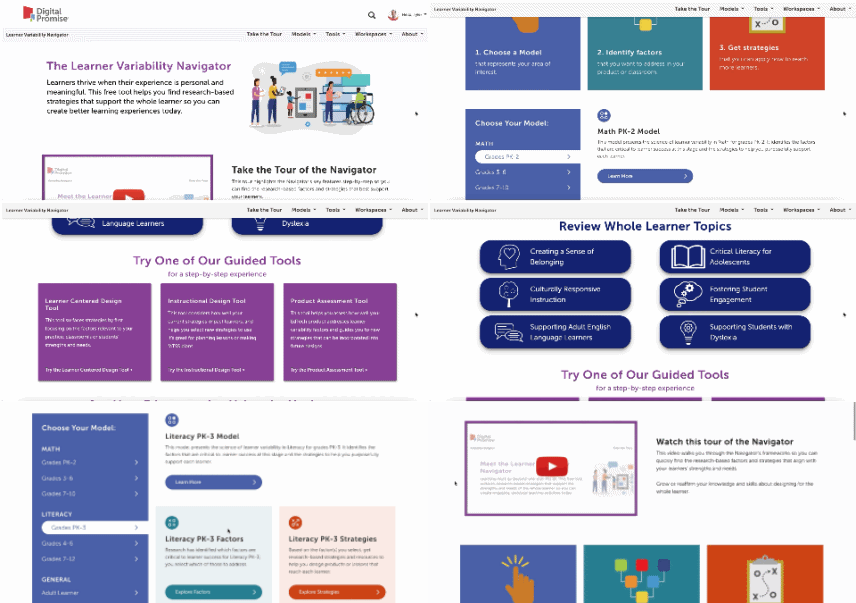
This is our homepage. You can access many of the features of the Navigator here, and learn more about how learner variability intersects with topics in education and learning. To start, select a content area – we call them Learner Models – to visit a factor map.
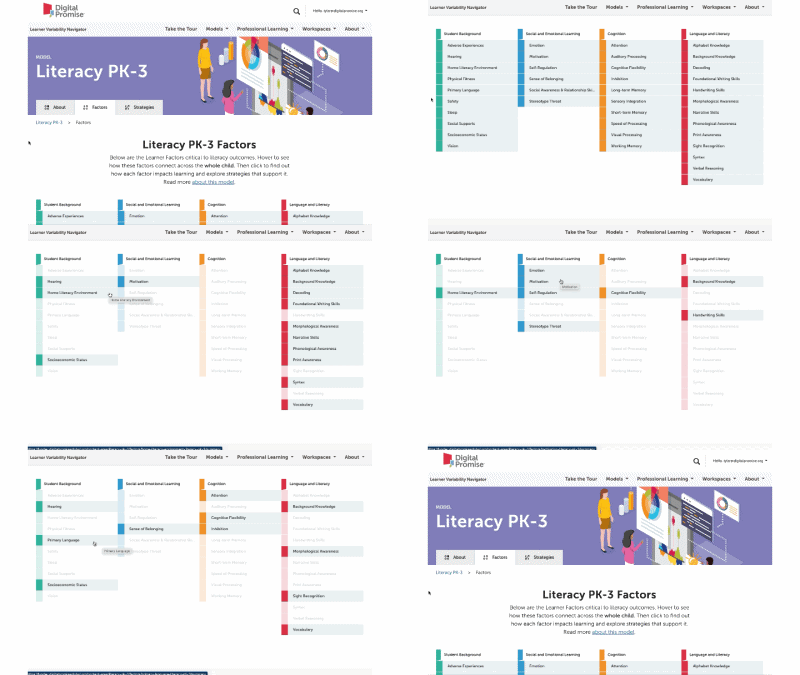
Factor maps show research-based concepts, "factors," that likely impact learning. They are organized into four categories: Learner Background, Social and Emotional Learning, Cognition, and Content Area. The map is interactive. Move your cursor over a factor to see connected factors. Select any factor to visit its summary page. We'll look at factor summary pages next.
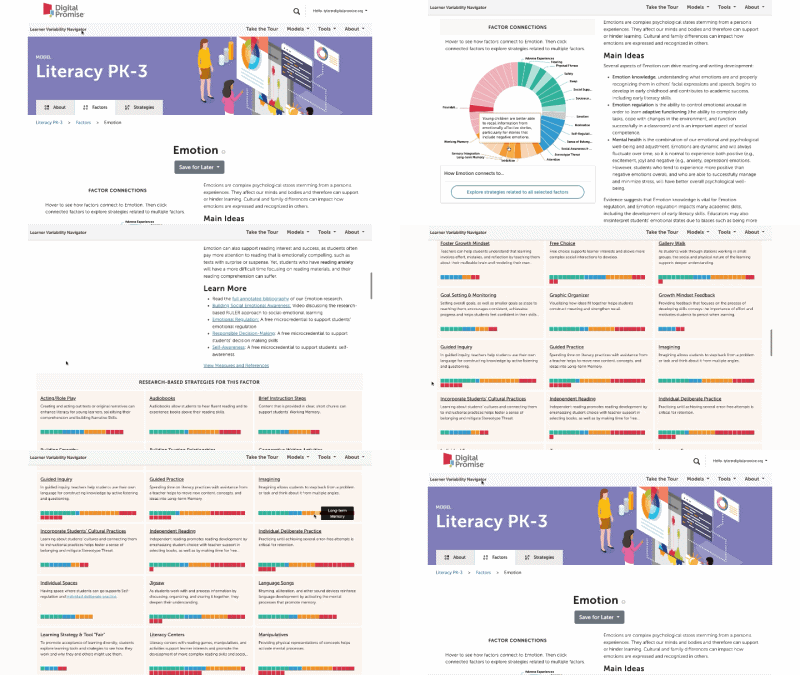
This is a factor summary page. It provides a brief definition and review of the factor, a factor connections diagram, additional resources, and strategies that support this factor. On the strategy card, the multi-colored boxes show all the factors that it supports. Select a strategy to visit its summary page.
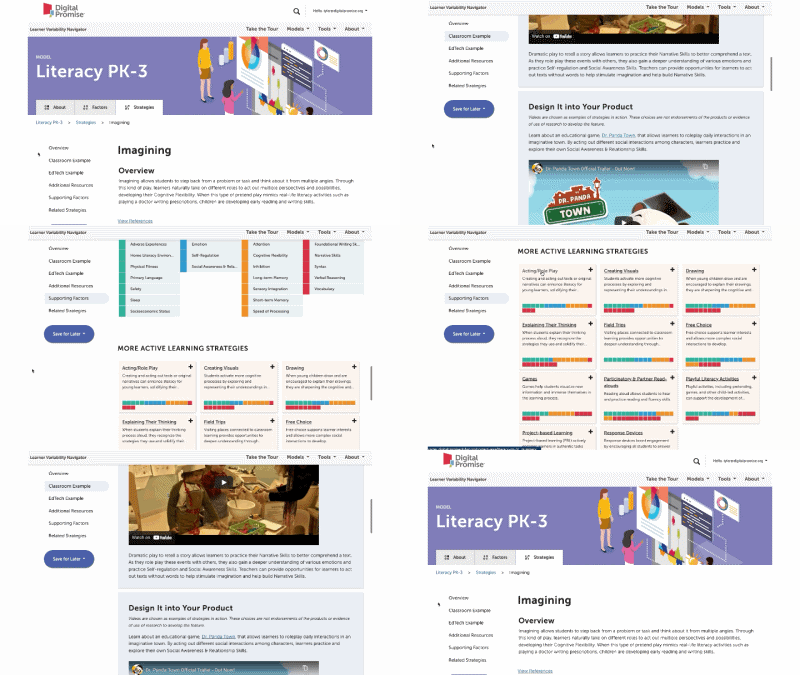
Strategy summary pages have an overview, information about using the strategy in different learning environments, resources of interest, the factors this strategy supports, and related strategies you can explore. To view all the strategies in a content area, use the strategies tab at the top of the page. We'll look at all the Strategies for this learner model next.
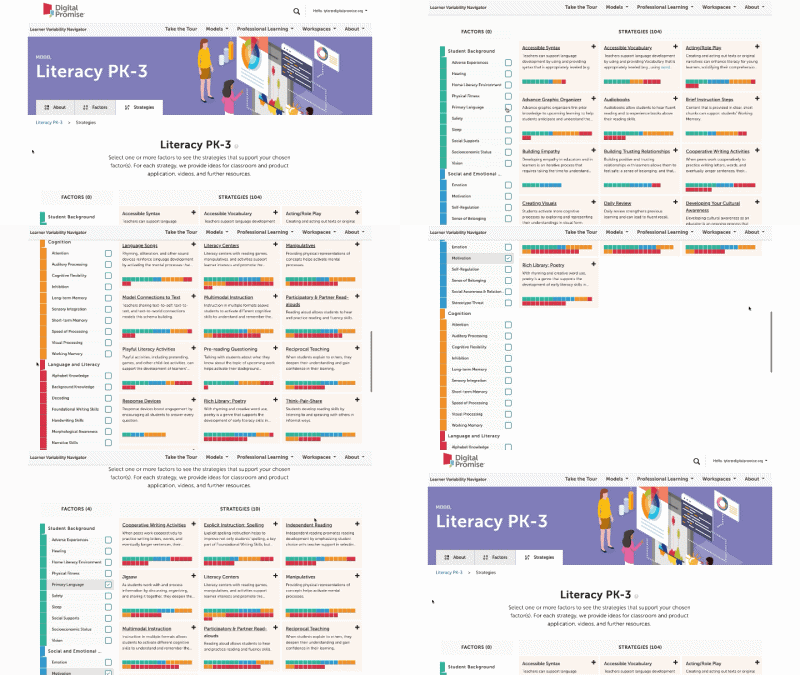
The strategy page shows ALL of the strategies for that learner model. You can select factors of interest for you or your learners, and it will narrow the strategies to only those that match all of the factors selected. This makes it easy to find key strategies to better design for learner variability. Again, select the strategy name to visit its summary page.


Already a user? LOG IN
Are you sure you want to delete this Workspace?
Enter the email address of the person you want to share with. This person will be granted access to this workspace and will be able to view and edit it.
Adjust the permissions of your Workspace.
This Workspace is .
This Workspace's Reflection Area is .
Learner variability is the recognition that each learner is a unique constellation of strengths and challenges that are interconnected across the whole child. Understanding these connections and how they vary according to context is essential for meeting the needs of each learner.
It disrupts the notion of a one-size-fits all education. Understanding learner variability helps educators embrace both students’ struggles and strengths as we connect practice to uplifting the whole learner.
Throughout the site, we talk about "factors" and "strategies." Factors are concepts research suggests have an impact on how people learn. Strategies are the approaches to teaching and learning that can be used to support people in how they learn best.
Use the Learner Centered Design Tool to build a workspace. Go to Learner Centered Design Tool.
Or, create a new blank workspace for your product or project.
Use one of the guided tools to build a workspace.
Or, create a new blank workspace for your product or project.
Make a copy of this workspace.
Redirecting soon...
Generating summary page
Loading...
On this page, using your heatmap, you will be asked to select factors to further explore, and then select new strategies you might incorporate into upcoming instruction. Once done, click “Show Summary" to view your Design Summary Report.
On this page, using your heatmap, you will be asked to select factors to further explore, and then select new strategies you might incorporate into upcoming instruction. Once done, click “Show Report” to view your Design Summary Report.
By selecting "Show Report" you will be taken to the Assessment Summary Page. Once created, you will not be able to edit your report. If you select cancel below, you can continue to edit your factor and strategy selections.
Announcement here
Item successfully added to workspace!
Issue adding item to workspace. Please refresh the page and try again.
Learner variability is the recognition that each learner is a unique constellation of strengths and challenges that are interconnected across the whole child. Understanding these connections and how they vary according to context is essential for meeting the needs of each learner. It embraces both students’ struggles and strengths. It considers the whole child.
Throughout the site, we talk about "factors" and "strategies." Factors are concepts research suggests have an impact on how people learn. Strategies are the approaches to teaching and learning that can be used to support people in how they learn best.
The Learner Variability Navigator is a free, online tool that translates the science of learner variability into factor maps and strategies that highlight connections across the whole learner. This puts the science of learning at teachers' fingertips, empowering them to understand their own practice and support each learner.
